.png)
Official Presenter:
The Maritime Fishermen's Union
Big news. We are proud to announce that the Maritime Fishermen's Union (MFU) is the Official Presenter of the 77th edition of the Shediac Lobster Festival, July 4 to 12, 2026. This partnership goes far beyond a logo on a banner. The MFU is headquartered right here in Shediac. Its members are the inshore fishermen who take to the sea each season to bring us the lobster we celebrate. Since 2018, the MFU has invested over $7 million in donations and $12 million in community projects supporting the inshore fishery, driven by a simple belief: when fishing communities thrive, the entire region benefits. It only made sense that those who bring us the lobster should be the ones presenting the festival that celebrates it. We are honoured to welcome the MFU at the heart of the 77th edition.
The Shediac Lobster Festival, presented by the Maritime Fishermen's Union.

Did you know?
1.
After hatching, lobster larvae spend several weeks in the water column, where they are part of the plankton, before settling to the ocean floor. At this stage, the larvae are most vulnerable to predation and other natural causes of mortality.
2.
Female lobsters can carry between 5,000 and 100,000 eggs at a time. They carry their eggs for 9 to 12 months before the larvae hatch. Lobster fishermen return these egg-bearing females to the water to support the species’ sustainability.
3.
Lobster fishermen use tools and practices that help ensure the sustainability of
the species. For example, lobster traps include escape mechanisms (small exit
openings) that allow undersized lobsters to get out.

4.
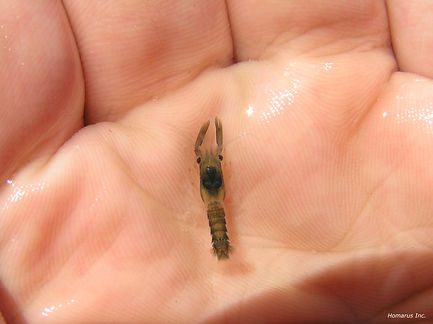
During the Lobster Festival’s lobster seedling release event, the Homarus team releases 10,000 stage 4 larvae into the sea. These larvae are counted by hand at the hatchery located at the Marine Center in Shippagan. The photo of the larva in a fisherman’s hand shows you the size of a stage 4 larva. Stocking carried out in this way increases the larvae’s chances of survival to 40% compared to natural hatching.

5.
During the Lobster Festival’s lobster seedling release event, the Homarus team releases 10,000 stage 4 larvae into the sea. These larvae are counted by hand at the hatchery located at the Marine Center in Shippagan. The photo of the larva in a fisherman’s hand shows you the size of a stage 4 larva. Stocking carried out in this way increases the larvae’s chances of survival to 40% compared to natural hatching.


6.
The lobster’s preferred prey in the Northumberland Strait is the common crab. However, lobsters are opportunistic and eat several types of prey, such as starfish, fish, and clams. The photo below shows a common crab.

7.
Lobsters taste with their legs. Small hairs on their legs serve as taste receptors.


8.
The lobster has no internal skeleton but rather a skeleton on the outside, called an exoskeleton, which is what we refer to as its shell. And it changes its shell about once a year. This molt allows it to increase its size by 10 to 15% and its mass by nearly 40%!
9.
Lobster fishing is one of the best-managed fisheries. The number of lobster fishing licences is fixed, therefore, for a new fisher to join the fleet, they must buy a licence from a fisher leaving the industry.
Fishers must respect fishing seasons and zones. They have a limit on the number of traps they can set, and these traps must have escape mechanisms that allow young lobsters to get out. Additionally, any lobster caught must meet a minimum size to be brought ashore.
All these measures support the species' long-term sustainability.